
Why XBT block “health” scores look terrible, and what they really mean
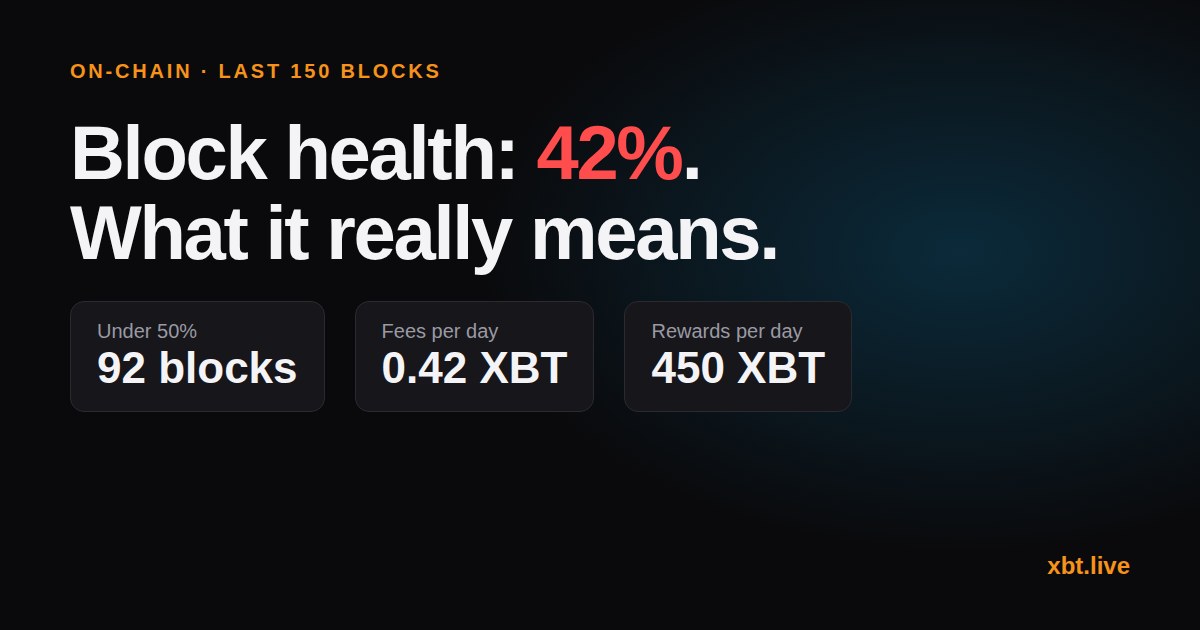
Open almost any recent XBT block on mempool.guide and the "health" score is red. In the last 150 blocks, the median was 42%, and 92 of them scored under 50%. Every pool shows it. It looks alarming. Here's what the number measures, and why it's low.
What "health" means
Block health is not a safety score. The explorer builds its own guess of the next block from the transactions its node has seen, then compares that guess with the block a miner actually found. 100% means they match. A low score means the miner's block looked different, usually much smaller, than the explorer expected.
What we found
| Last 150 blocks (976,888 to 977,037) | |
|---|---|
| Median health | 42% |
| Blocks scoring 90% or higher | 33 |
| Blocks scoring 50% to 90% | 25 |
| Blocks scoring under 50% | 92 |
It isn't one pool. AlphaPool averaged 43%, Lazarus 59%, CONVOY 38%, B2Pool 38% and DxPool 70% over the same stretch. Block 977,030 is a typical low one: the explorer expected about 578 transactions, and the block carried 58. We checked 40 of the transactions it left out. All were ordinary small transfers, no spam, and every one was confirmed in a later block.
Why it happens
- Fees are close to zero. All the fees in a day of XBT blocks add up to about 0.42 XBT, against 450 XBT in block rewards. A full block earns a miner roughly a dollar more than a near-empty one, and a bigger block takes slightly longer to spread across the network. There's almost no reason to fill blocks.
- Mempools don't agree. About 95% of XBT transactions are copies of bitcoin transactions (our check). They get pushed onto the network unevenly, so the explorer's node can be holding hundreds of transactions that a pool's node hasn't seen yet.
- Templates differ. Many miners build their own blocks with DATUM, on their own nodes with their own settings. That's good for decentralization, but every node's view of the mempool is a little different.
We can't prove which of these matters most for any one block. The fee math alone explains a lot.
Does it matter?
- For security, no. The blocks are valid and the chain is extending normally.
- For users, a little. A low-fee transaction might wait an extra block or two. Paying slightly above the minimum fee helps.
- Long term, yes. When the block reward shrinks, fees have to pay miners. On XBT today they pay almost nothing. More real use is what fixes that.
Block audit data from mempool.guide, Oct 13, 2026. Thanks to @cutty9 for asking.
Have an XBT story? Write for xbt.live.