
They can't just switch pools. BIP-110 proved who runs SHA-256.
The comforting story says that if a mining pool turns on the network, hashers will simply point their machines somewhere else. On SHA-256 Bitcoin that story is no longer true, and BIP-110 signaling day showed it. Marcellus (@oomahq) and Matt Kratter of Bitcoin University have laid out why. The best reply the other side could manage was one word from Giacomo Zucco: "Nonsense."
The verdict: the pools hold the power now
Marcellus calls BIP-110 the most important Bitcoin event of the 2020s, ahead of Taproot, and he's right. For years pools were too centralized for the textbook game theory to hold, but they kept up appearances and deferred to node runners. On mandatory signaling day they stopped pretending. The dominant Stratum V1 pools pushed a large group of users off the network rather than fix the bugs those users were trying to fix.
The precedent is the point. A handful of pool operators showed they can decide which rules win and leave anyone who objects on the other side of a split. Anyone who relied on pools to ignore a user-activated soft fork, instead of running a user-rejected one themselves, handed that power over. It will be used again.
Why "just switch pools" is a myth for the hash that matters
Kratter draws the line that settles the argument. Hashers run the machines. Miners, in the strict sense, build the block template and decide what goes in a block. On SHA-256 almost every hasher has handed that second job to a pool.
Can you or I repoint a few machines in a minute? Sure. But the hash that decides fights isn't ours. As Bitcoin Mechanic puts it in the clip Kratter plays, leaving a pool used to mean changing a URL, back when miners walked away from GHash.io. Now the big pay-per-share pools come with full KYC and mountains of compliance paperwork. A public miner's compliance department could need nine months to move, and its investors barely know what a 51% attack is.
Kratter's example is CleanSpark. Citing the company's own filings, he says Foundry was 100% of its mining revenue in the years ended June 2025 and June 2026. With roughly 4.4% of global hash rate, CleanSpark finds about six blocks a day. It doesn't need a pool at all, and uses one anyway. A company that answers to shareholders and regulators is not going to leave Foundry to defend node runners, and it couldn't change what goes in its blocks if it wanted to, because it doesn't build them. By Kratter's count five pools, AntPool, Foundry, F2Pool, ViaBTC and SpiderPool, decide what goes into most SHA-256 blocks, with AntPool near 31% and Foundry near 25%.
"Nonsense" is the problem in one word
Zucco's answer to all of this was "Nonsense," and elsewhere he has called BIP-110 a non-event worth studying only for its lessons about validity rules, standardness policy and protocol change. That is exactly the attitude Marcellus is describing. A large group of users was split off the network, the pools decided the outcome, and some of the best-known voices on the SHA-256 side treat it as a seminar topic rather than a warning. If the people who should be most alarmed by pool power wave it away in one word, the hashers who depend on those pools certainly won't act.
XBT has to do better, and the tools are there
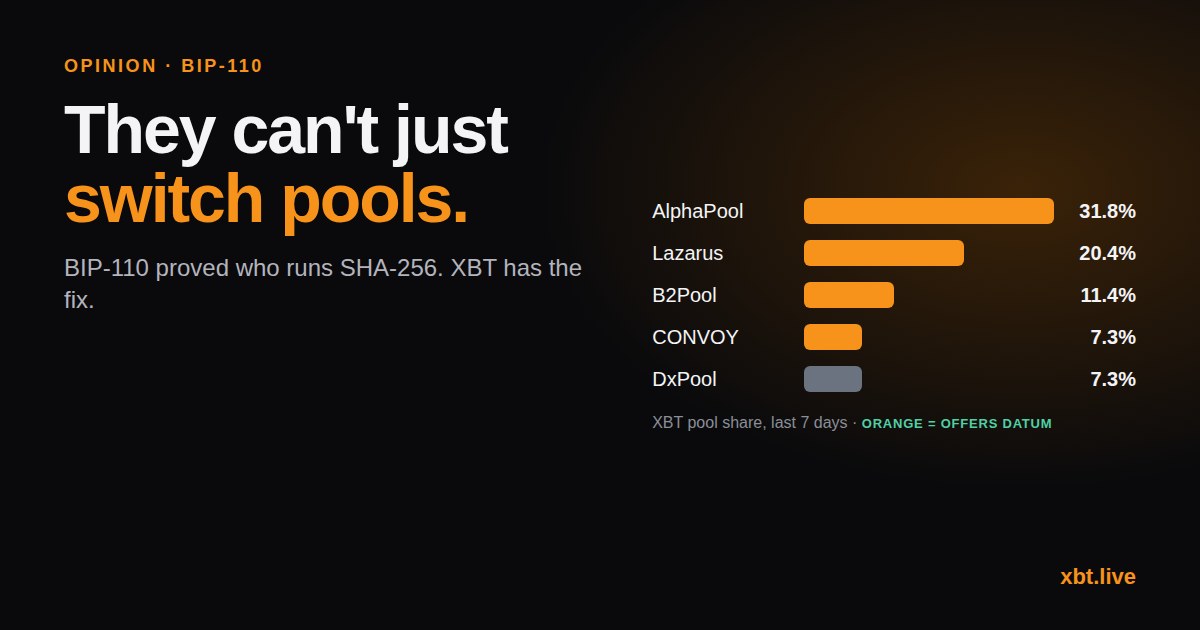
XBT inherited Bitcoin's mining design, and it would be dishonest to pretend it has escaped the problem. Over the last seven days (1,213 blocks, as of Oct 9):
| Pool | Share of blocks (7d) | DATUM (build your own template) |
|---|---|---|
| AlphaPool | 31.8% | Yes |
| Lazarus | 20.4% | Yes |
| B2Pool | 11.4% | Yes |
| CONVOY | 7.3% | Yes |
| DxPool | 7.3% | Not listed |
| 33 pools in total | Top 3: 63.6% | 7 of the 10 pools we track |
The top pool finds almost a third of blocks, the same as AntPool. The difference is who builds the block. All four of XBT's biggest pools offer DATUM, which lets a hasher build their own block template with their own node while still sharing rewards through the pool. On XBT the template does not have to belong to the pool. There's no KYC wall to climb, no nine-month compliance review, no Foundry in the way.
That only matters if hashers use it. The lesson of BIP-110 is that power left with pool operators gets used by pool operators. XBT miners have the option SHA-256 hashers gave up. Use it.
Mining XBT? Run DATUM so your own node builds your blocks, or point your hash at a smaller pool. Watch concentration week by week on the pool share chart.
Compare pools and DATUMPool share over time
Hat tip to Matt Kratter (Bitcoin University) and Marcellus (@oomahq) for the video and post that started this discussion.
Opinion. Not financial advice. SHA-256 figures (pool shares, CleanSpark revenue and hash rate) are as stated by the speakers in their public posts and video; we have not independently verified them. XBT pool data from block explorers via xbt.live.